Tuesday, May 21, 2013

Abenomics Fails to Spur Business Spending

I recently pointed out that the 3.5% boost in Japan’s statistical GDP has not reflected on real economic growth for the basic reason that monetary policy induced price distortions impede economic calculation and promotes discoordination. And that such growth has merely represented the frontloading of spending actions in view of forthcoming higher taxes.

We have anecdotal proof on this:

From the Bloomberg’s today’s Abe’s Resurgent Japan Hurt by Lack of Business Spending (bold mine)
As Japan’s cherry trees bloomed and the stock market soared, Kohetsu Watanabe flew to a blossom-viewing party in Tokyo hosted by Prime Minister Shinzo Abe to tell the premier personally how bad things really are.

When the head of machine-parts maker Daikyo Seiki Co. shook hands with Abe at the 12,000-guest event in Shinjuku Gyoen park, he says he begged the premier to help small- and medium-sized companies that make up 70 percent of Japan’s industry.

“Stocks and the yen may have come back, but the state of the real economy is very different,” said Watanabe, 49, who has no plans to raise wages for his 17 employees and hasn’t paid a bonus since 2008. “It’s impossible for me to be optimistic.”

His company in Akita, northern Japan, highlights the hurdle Abe faces in his quest to end 15 years of deflation and reinstate Japan as a pillar of the global economy. The first two “arrows” of so-called Abenomics, fiscal and monetary stimulus, have caused shares to rise and the yen to slump. While that helps exporters, it means more expensive imported materials and energy for Watanabe. With sales taxes set to rise in April, Abe’s third arrow -- restructuring rules to help businesses -- probably will take too long or be too watered down to prevent a drop in domestic demand next year.
What’s Japan’s real structural problem? From the same article:
With executives such as Watanabe waiting for earnings to improve before raising salaries, that pain may last beyond next year as the government faces opposition to dismantling decades-old policies, such as labor laws that make it difficult to fire workers.
How will such distortive labor regulations be eased by Abenomics?
In his May 17 speech, Abe said he wants to boost private investment to 70 trillion yen ($683 billion) a year -- the level before the 2008 financial crisis -- through deregulation, taxes, spending and equipment-leasing deals. He aims to triple infrastructure exports to about 30 trillion yen by 2020…
Yet the bias for the politicization of the marketplace:
The measures announced so far don’t go far enough, according to Izumi Devalier, an economist at HSBC Holdings Plc in Hong Kong, who says major restructuring is needed in agriculture, health care and labor laws…

“The Cabinet appears to be shying away from deregulation, opting instead to use subsidies and usual government-support programs,” Devalier wrote in a May 14 research note.
Just think of it; how will business investments and domestic demand improve when increasing taxes means a diversion of resources from the private sector to the government? 

Whatever money government spends is money that the private sector won’t be spending. These are called opportunity costs and the crowding out effect from government interventions. 

Yet government spending will be financed by more debt in the light of continuing weak business environment burdened by taxes and constrained by price instability. So Abenomics essentially will compound on her precarious nearly 220% debt to gdp.

Yet the above account shows how the Japanese government refuses to deal with the stringent labor laws that has choked the economy.  

Japan's rigid immigration laws represents as another vitally important structural hindrance which politicians refrain from reforms.

This shows that in politics, there is no such thing as economic logic, thus the tendency to deal with superficialities or treating the symptom rather than the disease.

Well of course, the Abenomics path of “subsidies and usual government-support programs” has been tried and tested since the Japanese bubble imploded in 1990s.

Let me quote in length Douglas French’s narrative of the doing the same thing over and over again yet expecting different results:
The Japanese government didn’t just leave matters to the monetary authorities. Between 1992-1995, it tried six stimulus plans totaling 65.5 trillion yen and even cut tax rates in 1994. It tried cutting taxes again in 1998, but government spending was never cut.

In 1998, another stimulus package of 16.7 trillion yen was rolled out, nearly half of which was for public works projects. Later in the same year, another stimulus package was announced, totaling 23.9 trillion yen. The very next year, an 18 trillion yen stimulus was tried, and in October 2000, another stimulus of 11 trillion yen was announced.

During the 1990s, Japan tried 10 fiscal stimulus packages totaling more than 100 trillion yen, and each failed to cure the recession.

In spring 2001, the BOJ switched to a policy of quantitative easing — targeting the growth of the money supply, instead of nominal interest rates — in order to engineer a rebound in demand growth.

The BOJ’s quantitative easing and large increase in liquidity stopped the fall in land prices by 2003. Japan’s central bank held interest rates at zero until early 2007, when it boosted its discount rate back to 0.5% in two steps by midyear. But the BOJ quickly reverted back to its zero interest rate policy.

In August 2008, the Japanese government unveiled an 11.5 trillion yen stimulus. The package, which included 1.8 trillion yen in new spending and nearly 10 trillion yen in government loans and credit guarantees, was in response to news that the Japanese economy the previous month suffered its biggest contraction in seven years and inflation had topped 2% for the first time in a decade.

In December 2009, Reuters reported, “The Bank of Japan reinforced its commitment to maintain very low interest rates on Friday and set the scene for a further easing of monetary policy to fight deflation. The bank said that it would not tolerate zero inflation or falling prices.”

In a paper for the International Monetary Fund entitled Bank of Japan’s Monetary Easing Measures: Are They Powerful and Comprehensive?, W. Raphael Lam wrote that the BOJ had “expanded its tool kit through a series of monetary easing measures since early 2009.” The BOJ instituted new asset purchase programs allowing the central bank to purchase corporate bonds, commercial paper, exchange-traded funds (ETFs), and real estate investment trusts (REITs).

According to Lam’s work, the BOJ bought 134.8 trillion yen worth of government and corporate paper between December 2008 and August 2011. Lam described the impact of these purchases as “broad-based and comprehensive,” but it failed to impact “inflation expectations.”

For more than two decades, the Japanese central bank and government have emptied the Keynesian tool chest looking for anything that would slay the deflation dragon. Reading the hysterics of the financial press and Japanese central bankers, one would think prices are plunging. Or that borrowers cannot repay loans and the economy is not just at a standstill, but in a tailspin. Tokyo must be one big soup line.
At the end of the day, all the hero worship on Abenomics or Japan inflationism as elixir will turn out badly for the simple reason that, as I recently wrote:
Abenomics operates in an incorrigible self-contradiction: Abenomics has been designed to produce substantial price inflation but expects interest rates at permanently zero bound. Such two variables are like polar opposites. Thus expectations for their harmonious combination are founded on whims rather from economic reality.
Abenomics will advance on Japan’s coming debt crisis.

Monday, May 20, 2013

Video: Peter Schiff: This time it is different, it will be a lot worse

This time is different, it will be a lot worse, says Peter Schiff speaking at the 2013 Las Vegas MoneyShow. 

Mr Schiff's talk covers a wide range of interrelated topics from today's deja vu of 2006 in terms of steroid induced market euphoria, the bond market ponzi scheme, the Fed exit's bluff, manipulation of price inflation and growth statistics, runaway inflation and hyperinflation and the gold bubble (a bubble which ironically hardly anybody from Wall Street owns). (hat tip Lewrockwell.com)

Graphics: Here Comes Super-Abenomics!

image

The worship of inflationists and the religion of inflationism has reached new heights. Yes we are at the pinnacle of the central banking-inflationism bubble.

As the great Ludwig von Mises once wrote, “The favor of the masses and of the writers and politicians eager for applause goes to inflation.”

Yet all such optimism looks nothing new. The following article from the New York Times in March 1999 showcases an almost similar level of optimism where interventionism has been seen as an elixir to Japan’s economy.

image

Fourteen years after, yet still the hope for political magic to work.

The Flaws of BSP’s Real Estate Monitoring and Banking Stress Tests

Rushing in defence over growing concerns of the risks of asset bubbles, the Philippine central bank, the Bangko Sentral ng Pilipinas conducted a real estate exposure test monitoring which included a partial banking stress test[1].

In the report the BSP has not explicitly issued a confirmation or a denial of the risks of a domestic bubble. But they placed into the context the following

-The Philippines’s total banking exposure on real estate was at Php 821.7 billion as of December 2012.

-The BSP continues to monitor the 20 percent cap on RELs since 1997 where current report includes “loans by developers of socialized and low-cost housing, loans to individuals, loans supported by non-risk collaterals or Home Guarantee Corporation guarantee as well as exposures by bank trust departments and thrift banks.”

-The thrust to examine the banking sector’s exposure in real estate “is in line with the BSP’s pursuit of financial stability”

-The BSP hasn’t shown any signs of worries, due to stable non-performing RELs ratio which was “reported at 3.7 percent as of end-December 2012”

-And the BSP seems confident there is enough capital to withstand any potential shocks “with capital adequacy ratio of tested U/KBs and TBs will stand at 15.77 percent despite a 50 percent simulated default on residential real estate loans.”

First of all, the BSP does not mention that Real Estate Loans (REL) at 821.7 billion pesos and with a total loan portfolio TLP (net of interbank lending) of 3,938.9 billion pesos, real estate loans as a share of TLP would now account for 20.86%.

And so if my interpretation of their data is accurate then the banking sector has essentially hit its speed limits on issuing loans to the property sector. Will the BSP put on the brake and reverse the boom? How?

Next, it isn’t clear what the BSP means by “financial stability”? If they are referring to controlling price inflation my question is—are there no opportunity costs in in implementing “financial stability” measures? Or why should moderating price inflation come at the costs of blowing asset bubbles?

Let me cite the former chief of Monetary and Economic Department at the Bank of International Settlement’s William R. White in his 2006 paper who argued against price stability policies (bold mine)[2]
…price stability is indeed desirable for a whole host of reasons. At the same time, it will also be contended that achieving near-term price stability might sometimes not be sufficient to avoid serious macroeconomic downturns in the medium term. Moreover, recognising that all deflations are not alike, the active use of monetary policy to avoid the threat of deflation could even have longer term costs that might be higher than the presumed benefits. The core of the problem is that persistently easy monetary conditions can lead to the cumulative build-up over time of significant deviations from historical norms – whether in terms of debt levels, saving ratios, asset prices or other indicators of “imbalances”.
Also Non Performing Loans (NPLs) are coincident if not lagging indicators. NPLs are low because the current boom continues. NPLs become reliable indicators, when asset quality deteriorates or when the credit boom is in the process of reversing itself into a bust. Again they are coincident if not lagging indicators.

In addition, the BSP appears to have isolated its bank stress test by limiting “simulated default on residential real estate loans”. Why? Doesn’t the BSP know that economies are complex and vastly interdependent such that economies do not operate on isolation as the BSP model presumes?

A bursting bubble will ripple through not only through the residential real estate segment but would also impact commercial property sectors (office, shopping malls, casinos etc...) or firms that are highly leveraged.

More importantly, once the real estate sector gets slammed by the entwined factors of financial losses and deleveraging, such will likewise impact all sectors that have exposure on them, and so with the banks.

And affected secondary sectors will also hit firms from different industries connected to them, and so forth.

Thus the complex latticework of commercial networks means that the feedback mechanisms from the bubble busts will have a domino effect and thus spawn a crisis.

So models will not be able to capture the contagion effects from a real-estate-stock market bust for the simple reason that models tend to mathematically oversimplify what truly is a complex reality.

The fundamental flaw with BSP’s implied defence of the risks of asset bubbles has been to interpret statistics as economics.
image

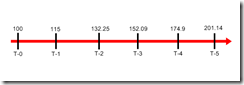
The above diagram represents the compounded average of 15%. A compounded average of 15% means a doubling of anything in 5 years. This applies to leveraging or economic imbalances.

Let us assume that a doubling of leveraging or imbalances will put an economy to a state of vulnerability to financial risks. It would not be helpful to say that, if we are at the T-3 stage, where statistics show only 152.09, to claim that there is no risk because of the current state. While such statement may be true, it essentially denies the imminence based on the trajectory.

In other words, the shifting of the burden of risk analysis from the rate of growth to reading today’s numbers would represent as misleading analysis and a denial.

The same logic applies to a pre-debt crisis build up as shown by history.
.image

In the chronicle of about 250 crisis in 8 centuries, Harvard’s Carmen Reinhart and Kenneth Rogoff notes of the same pattern[3] (bold mine)
domestic debt is not static around default episodes. In fact, domestic debt often shows the same frenzied increases in the run-up to external default as foreign borrowing does. The pattern is illustrated in Figure 5, which depicts debt accumulation during the five years up to and including external default across all the episodes in our sample. Presumably, the comovement of domestic and foreign debt is produced by the same procyclical behavior of fiscal policy documented by previous researchers. As shown repeatedly over time, emerging market governments are prone to treating favorable shocks as permanent, fueling a spree in government spending and borrowing that ends in tears.
Again it is the trajectory that matters.

In short, it is the presence or absence of the factors that drives the incentives for these frenzied desire to accumulate debt that needs to be identified and curtailed.

Unfortunately since the genesis of such incentives have been political which have been effected through social policies, and from which the untoward impact from such polices are invisible and incomprehensible to the public, such policies will hardly be stopped until a blowback from the marketplace occurs.

And as for the state of euphoria, where governments think that they have reached a state of presumed perfection, the passing of the bank stress test in Cyprus in 2011 should serve as a fantastic example:

From the Cyprus Mail[4],
In Nicosia the Finance Ministry issued a statement saying: “The measures which the banks are taking or planning to take will further increase solvency.”

The statement also referred to a “removed possibility” of having to support the banks, stating the government was ready to “immediately take any necessary measures to maintain financial stability.”

BoC “successfully passed the test” because of its strong capital base, fluidity and satisfactory profitability, Bank of Cyprus’ Chief Executive Officer, Andreas Eliades.
Strong capital base, fluidity, increase solvency and satisfactory profitability, all turned on its head, March this year. The rest is history.

I know, the Philippines is not Cyprus. But the important lesson from the Cyprus episode is one of overconfidence that leads to complacency that further enhances systemic buildup of risks.

Remember bubbles are manifestations of the reflexive feedback loop between expectations as influenced by prices, and actions as influenced by expectations, which are enabled and facilitated by debt and incentivized by policies.

Overconfidence and complacency fosters systemic instability which is hardly “the pursuit of financial stability”

The BSP’s Wealth Transfer

image

These two charts embody the structural deficiencies of the Philippine political economy.

The BSP estimates that only 21.5% of households have access to the formal banking sector[5].

Yet domestic credit provided by the banking sector accounts for 51.54% of the GDP in 2011[6]. I would guess that the latter figure would be substantially higher today, given the credit boom mostly channelled through the banking sector.

Yet what these two diagrams say is that statistical economic growth has been immensely tilted towards those less than 21.5 households who have access and or have used credit from the banking system.

Not all depositors like me have used credit from the banking sector for whatever purpose. Yes I have credit cards but I which I use infrequently.

The BSP confirms this; they estimate that only 4% households have credit cards.

The lopsided exposure to the banking industry has been likewise reflected on the stock market.

image
As of 2011, according to Bloomberg/Matthews Asia[7] the wealthy elites control 83% of the market capitalization of the Philippine Stock Exchange

image
And considering the low penetration levels to the banking system and to the stock market, it would be even more conceivable that the general public hardly has any access to the more complex bond markets.

Again capital markets and the banking system have been greatly biased to the formal economy and to the oligarchs and plutocrats who control them.

Though we know that this has been an inherited problem, there has been little attempt by the powers-that-be to distribute them through liberalization ever since.

The procrastination by the PSE to hook up with the ASEAN trading link or the integration of ASEAN bourses[8] is an example. Philippine political and economic elites seem apprehensive over the prospects of losing their privileges with an ASEAN interconnection. The same applies with the lack of commodity markets where such markets would undermine the privileges of these plutocrats.

The much ballyhooed policy reforms has been more of the same. For example, government spending based on public-private partnerships, would only mean that the politically connected will be rewarded with such economic opportunities or concessions.

Yet foisting a zero bound rates in order to supposedly boost domestic demand doesn’t really help the real economy, for the simple reason that the informal economy has little direct access to the formal sector. And this will not change unless the government deregulates or liberalizes.

On the contrary credit easing policies has only boosted the wealth of the politically privileged elite.

As to quote anew the Atlantic[9]:
In 2012, Forbes Asia announced that the collective wealth of the 40 richest Filipino families grew $13 billion during the 2010-2011 year, to $47.4 billion--an increase of 37.9 percent. Filipino economist Cielito Habito calculated that the increased wealth of those families was equivalent in value to a staggering 76.5 percent of the country's overall increase in GDP at the time.
In short, BSP policies represent transfers of resources from the real economy to the political class (via bigger government spending and bigger bureaucracy) and politically connected economic elites.

Thus the manipulated boom, which has been peddled by media and bought for by the gullible public, has been used as license via populist mandate to extend on such privileges.

BSP’s Underbelly: The Philippines’ Shadow Banks

Now going back to the direction of BSP policies.

Promoting “domestic demand” through expanded access of credit has been the purported reason for zero bound rates and the lowering of interest rates of the SDAs[10].

Combine these with the recent credit rating upgrades from major international credit agencies, all these means subsidizing or rewarding debt. Thus the natural outgrowth of accelerating debt.

So the BSP’s direction has been to promote debt. But on the other hand they claim that they would regulate or control it. So the BSP essentially operates in a cognitive dissonance, holding two conflicting ideas as policies. This is a wonderful example of the idiom “the left hand doesn’t know what the right hand is doing”: a self-contradiction

Now that the real estate sector has reached its limits as noted above, the question is will the BSP act?

Even if the BSP does, I am quite sure that many market participants would resort to regulatory arbitrage to circumvent them.

They may shift the use of loans even if they are classified as non-real estate into real estate or into the stock market, such as the fateful Bangladesh stock market crash in 2011[11]. Banks may use off balance sheets. Others may resort to bribery.

Of course, given the huge domestic informal economy, the most likely avenue for regulatory arbitrage is to use the nexus between the formal and the informal economy: the shadow banking system.

The BSP believes that they have the banking sector within their palms, but the World Bank says otherwise 

image

Shadow banking system in Philippines and Thailand accounts for more than one-third of total financial system assets[12]. One would note in the right chart that the Philippine shadow banking system has seen an intensifying rate of growth which has polevaulted since 2009 and has nearly surpassed Thailand’s level.

Aside from common informal microfinancing[13] as 5-6 lending, “paluwagan” or pooled money, “hulugan” instalment credit, much of the growth in the shadow banking system has reportedly been in the real estate sector, particularly the in-house financing from developers[14].

The BSP claims that it would investigate[15] these even if they hardly control the formal system.

The shadow banking system has become a worldwide phenomenon and has grown to as high as $67 trillion in 2011 according to the CNBC[16] or nearly 83% of the $80 trillion world economy. The risks of the shadow banking sector doesn’t intuitively or automatically emerge out of “lack of regulation”, rather, the shadow banking industry has been largely a product of overregulation via regulatory arbitrage. Where an economic or financial system has been hobbled by politics, risks becomes centralized and thus systemic.

Bottom line: Loans to the real estate sector have significantly been more than the caps set by the BSP. Easy money policies have apparently filtered into the informal sector. This means systemic leverage has been far more than what the BSP oversees and supervises. Lastly the BSP hardly has solid control over the formal sector. The same is amplified with the informal or shadow banking system.

Like almost every central bankers today, BSP policies supposedly meant to promote “domestic demand” will be pushed to the limits, despite the rhetoric. And this will further fuel the mania phase in both the stock market and the property sector.


[2] William R. White Is price stability enough? Bank of International Settlement April 2006

[3] Carmen M. Reinhart and Kenneth S. Rogoff The Forgotten History of Domestic Debt September 21, 2010 Harvard University

[4] Cyprus Mail Cyprus banks pass EU stress test, July 16, 2011

[5] Bangko Sentral ng Pilipinas 2012 Annual Report Volume 1


[7] Kenneth Lowe Kicking the Tires Asian Insight Matthews Asia 2013


[12] Swati Ghosh, Ines Gonzalez del Mazo, and İnci Ötker-Robe Chasing the Shadows: How Significant Is Shadow Banking in Emerging Markets? World Bank September 2012


[14] Businessworld Research The pros and cons of shadow banking February 8, 2013


Phisix in the Shadow of Greed and Fear

Strange times are these in which we live when old and young are taught in falsehood's school. And the one man who dares to tell the truth is called at once a lunatic and fool. -- Plato

Up, up and away!

The Philippine Phisix only posted a marginal .24% gain this week. But on a weekly basis the local benchmark soared to an all-time high.

Such marginal gain reflects on this week’s sharp volatility, specifically the difference between the spike during the two post-election trading sessions and the subsequent profit taking at the close of the week which ended up with a residual net gain.

image

Year-to-date the Phisix has returned a fantastic 25.24% as of Friday’s close. We are fast closing in on the 32.95% annual return of 2012. Yet there are 7 months until the end of the year.

At the current rate of return of about 5% gain per month, if sustained, would translate to a 10,000 Phisix by the end of the year or at the first quarter of 2014.

The steepening of the ascending slope suggests of the deepening convictions of the bulls of the trend’s sustainability. Such convictions have now been strengthened by even more price increases.

But this seems to have morphed into more than just a reflexive feedback loop between expectations (shaped by prices) and outcomes (influenced by expectations); some people in social media have already been exuding an aura of invincibility by hectoring on very rare bearish international reports.

As I have said before[1], markets have hardly been pricing about “cheap” or “expensive” but about electrically charged emotions: Greed and Fear.

image

Sectoral returns have been demonstrating such dynamic.

Bulls have been swamping into popular investment themes, while the bears have frantically been smashing down what seems as ‘politically incorrect’ issues.

Bull markets tend to lift all, if not most issues, but apparently not this time.

Also, the annual rotational pattern has been broken. Instead of an alternating leadership as during the past 6-7 years, the mining sector has gone completely in the opposite direction of the general markets.

The decline in the mining issues has not been proportional. Some issues fell of the cliff where losses account for an astounding 50-70% from their recent zenith. 

Such dramatic selloffs and declines already exhibit a state of depression with hardly any “corporate fundamentals” to account for. Others have been down by 20-30%. I may add that the biggest losers have been those with operations within the Benguet area, so I am wondering whether domestic politics may have been aggravated the dour sentiment which has been partly imported.

So, on the one hand we see intensive yield chasing phenomenon. On the other, we see panic. Greed and Fear.

But what should concern serious participants is not the “fear”, but the dominant “greed” as manifested by a ballooning mania.

And I wouldn’t exactly characterize “greed” in the conventional sense, but rather greed in the context of expansive risk appetite as consequences from various social policies.

The public has been motivated to speculate from easy money policies and from implied guarantees on the financial market, thus the market has responded in such rampant and destabilizing manner.

When we tax something we get less of it, but when we subsidies something we get more of it. So this applies to stock markets too: Current policies subsidize or reward “greed”, and at the same time, punish “prudence”.

Even the Jaime Caruana, the chief of the Bank of International Settlements, or the central bank of all central banks, have come to recognize and warn about this[2].

Global Equity Markets Melt-UP

Year-to-date, major global benchmarks have seen a return of a RISK ON environment as the levitation of equity markets has been accelerating. 

image

The above table doesn’t give justice to the overall representation of the other bourses. This is due to the distortions from the magnified gains by Japan’s Nikkei which diminishes what should have revealed as outsized gains for developed economies and ASEAN equities

In the behavioral science field, this is called the perceptual contrast effect[3], where people’s judgement are shaped by perceptions framed from relative immediate or visible comparisons

Nonetheless, gains of major developed economies and ASEAN nations have been mounting while the BRICs seem to be recovering except for Brazil.

In observing price trends, the melt up in equity markets have become global.

image

The US major benchmark, the Dow Jones Industrials, as well as, Germany’s DAX index has shown upside acceleration. 

As of Friday’s close, the Dow Industrials has been up 17.2% year-to-date while the German DAX has been up 10.32%. In 2012, the Dow yielded gains of 6% while the DAX 29%.

As I have recently pointed out[4], the surge in the DAX comes in contrast with Germany’s struggling economy. Germany managed to eke out a .1% growth during the first quarter of the year. Whereas the overall direction of growth since 2011 has been on a downtrend, yet the German DAX seems on a melt up mode.

This Isn’t Your Daddy and Grand Daddy’s Market

The most striking parallel universe phenomenon would be in France.
image

French financial markets will tell you of a booming economy: 

The equity bellwether the CAC 40 has racked up gains of 9.89% year-to-date and was up 15.23% in 2012. Interest rates as measured by the French government 10 year yields[5] have been drifting at multi-year lows (see lower window).

So OECD France has a booming bond and the stock markets almost similar to the emerging market Philippines.

Ah, but France is not the Philippines. Ironically the French economy slipped into a recession in the first quarter of this year. For most of 2012, France has also been in periodical recessions. Yet the market booms. France was even downgraded by Moody’s last November[6]. But the stock and bond markets have ignored them. And this is why the French equity market seems in melt up mode even as the stagnating economy seems to intensify.

image
And given that the French economy has been hocked to the eyeballs with debt, as debt-to-gdp has been ballooning[7] since 2009, one would expect that the extended recessions would have amplified credit and market risks that should have roiled the financial markets.

image
But no, this time is different.

Bad news is good news. More signs of economic troubles translate to more prospects of accommodation from central banks. The more the bad news, the better for the financial markets.

In addition, central banks policies appear to have jaded the market’s perception of risks. French interest rates have gone down partly because of Japan government’s aggressive pursuit[8] of doubling her monetary base via “Abenomics”, where Japanese insurance and banking firms sought higher yields[9] (if not safehaven) from French bonds as shown above.

The Swiss National Bank (SNB) may have also been a party[10] to subsidizing the French government through accumulation of French bonds. 

Or it could be that French institutions with international exposure could have been downsizing partly by selling their holdings abroad from which they repatriate to buy French bonds for reserve requirements purposes.

Charles Gave of the Gavekal Research opines[11]
France has a large financial sector, with huge international positions. Some entities may be selling international holdings which demand large reserve requirements. The proceeds are then brought back in France to buy French government bonds—against which there are no reserve requirements.
As I earlier said, current developments reveal that there hardly has been anything fundamental in the traditional or conventional understanding from which current markets operate on.

This isn’t your granddaddy or your daddy’s financial markets.
image

Or take a look at three national benchmarks above.

All of them are apparently in a melt-up mode. Year-to-date the chart at the left has yielded 45.63%, the center 29.45% and the right 61.92% as of Friday’s close.

The melt-up for these three bellwethers has a common denominator: they have been spiked by strong monetary forces.

Argentina’s Merval[12] (center) and Venezuela’s Caracas[13] (right) have both been enduring hyperinflation but in different phases[14], their stock markets are proving to be partial safehavens. On the left is Japan’s Nikkei[15]. Japan’s Nikkei 225 has skyrocketed from the government’s plan to double her monetary base which is really is in the direction of Argentina and Venezuela except that Japan policies are in an embryonic phase.

Thus the conventional and popular wisdom where today’s market has been one about growth, or fundamentals or political salvation will be proven wrong in the fullness of time.

Again this isn’t your granddaddy or your daddy’s financial markets.


[3] ChangingMinds.org Perceptual Contrast Effect


[6] Guardian.co.uk Moody's downgrades France's credit rating to AA1 November 20, 2012

[7] Tradingeconomics.com FRANCE GOVERNMENT DEBT TO GDP

[8] Zero Hedge We Found The 'Other' Greater Fool May 13, 2013


[10] Wall Street Journal Button-Down Central Bank Bets It All January 8, 2013


[15] Bloomberg.com Nikkei 225

Sunday, May 19, 2013

Infographic: The Silver Squeeze

The following infographic courtesy of the Austrian Insider (hat tip Zero Hedge)
 
The Silver Squeeze – An infographic by the team at The Silver Squeeze Free Infographic

Quote of the Day: The Intelligencia pay no price for being wrong

Well, if you come up with a lot of wrong ideas and pay a price for it, you’re forced to think about it and to change your ways or else get eliminated. But there is no such test. The only test for most intellectuals is whether other intellectuals go along with them. And if they all have a wrong idea, then it becomes invincible.
This is from economic professor, author and political philosopher Thomas Sowell expounding a passage “The Intelligencia pay no price for being wrong” from his latest book Intellectuals and Race in a video interview with Wall Street Journal’s Peter Robinson. (hat tip Mises Blog)

Paying no price for being wrong can be seen in the same light as Nassim Taleb's “skin in the game”, the stakeholder’s dilemma or the principal agent problem—conflict of interests shaped by diverse incentives

This is very relevant not only to the participants of the financial markets but especially pronounced in public opinion arena where social policies are shaped. The crux: Bad ideas have consequences. And people with little “skin in the game” or “pay no price for being wrong” are the most notorious promoters of ‘noble sounding’ deceptive ideas.

Saturday, May 18, 2013

War on Cash: Nigeria and Ghana Experiment with Cashless System

Governments and banksters have been trying their darn best to put the savings of their constituencies on their palms.

African nations of Nigeria and Ghana will be experimenting with cashless transactions.

The Nigerian program from theNextweb.com
Last week at the World Economic Forum on Africa held in Cape Town, South Africa the Nigerian National Identity Management Commission (NIMC) and MasterCard announced their collaboration with plans to roll-out an initial 13 million MasterCard-branded National Identity Smart Cards with electronic payment capability.

The 13 million cards will form part of a pilot program which will see the West African country’s citizens who are 16 years and older and those who have been residents in Nigeria for more than two years being issued with the new National Identity Smart Cards.

This announcement by Nigeria sees it following in South Africa’s footsteps as the country’s Department of Home Affairs has announced that it intends starting to issue smart ID cards to citizens starting in July, 2013 at a rate of  3 million smart ID cards a year.

It is hoped in both cases that the smart ID cards will help curb the prevalent fabrication of false identity documents in both Nigeria and South Africa as they will be embedded with microchips and with the South African smart ID cards being reported to incorporate biometric features that will also prevent identity theft as a result of the fraudulent use of a stolen or lost smart ID card.

There is also a notable difference between the South African and Nigerian smart ID cards with the West African country’s smart ID cards coming with immediate payment capability’s courtesy of MasterCard’s prepaid payment technology. The cards are also reported to come loaded with 12 other applications.

The cashless project in Ghana from the spyghana.com
Ghana, as a developing country in West Africa has taken the initiative to introduce a system where businesses can be done without using physical cash. Bank of Ghana, the regulator of the banking industry through Ghana Interbank, Payment and Settlement Systems (GhiPPS) introduced e-zwich card, where Ghanaians will feel comfortable in using the card to transact businesses rather than physical cash.

Even though there has been several effort to educate the masses about the product, the education on this e-zwich have not go well with many Ghanaians. A lot of the citizens as of today do not even know there is something called e-zwich card. With a population more than half of it been illiterate, there must be a thorough education where all Ghanaians will understand and use the platform.

In Ghana, some of the common cards we can identify are such as Sika Card by SSB, Visa Horizon by Standard Chartered Bank (Stored Value cards), deployment of Automated Teller Machines (ATM) and ATM cards by banks eCard (CAL Bank, Ecobank) and among others.
Harmless they all seem. But centralization means that people's lives will increasingly be subject to government control. Identity cards can be easily altered, changed or subjected to manipulations upon government's whim. These will be like sci-fi movies where people's identities can be wiped out or expunged through programming: You are alive, but you don't exist says the system
 
This also shows why governments will attack gold, bitcoins and cash, and in their stead promote centralized systems based on national IDs complimented by facilities of digital cash payments systems and other 'flavoring' or "add on" called applications.  Such systems will make confiscations and totalitarianism a cinch.